

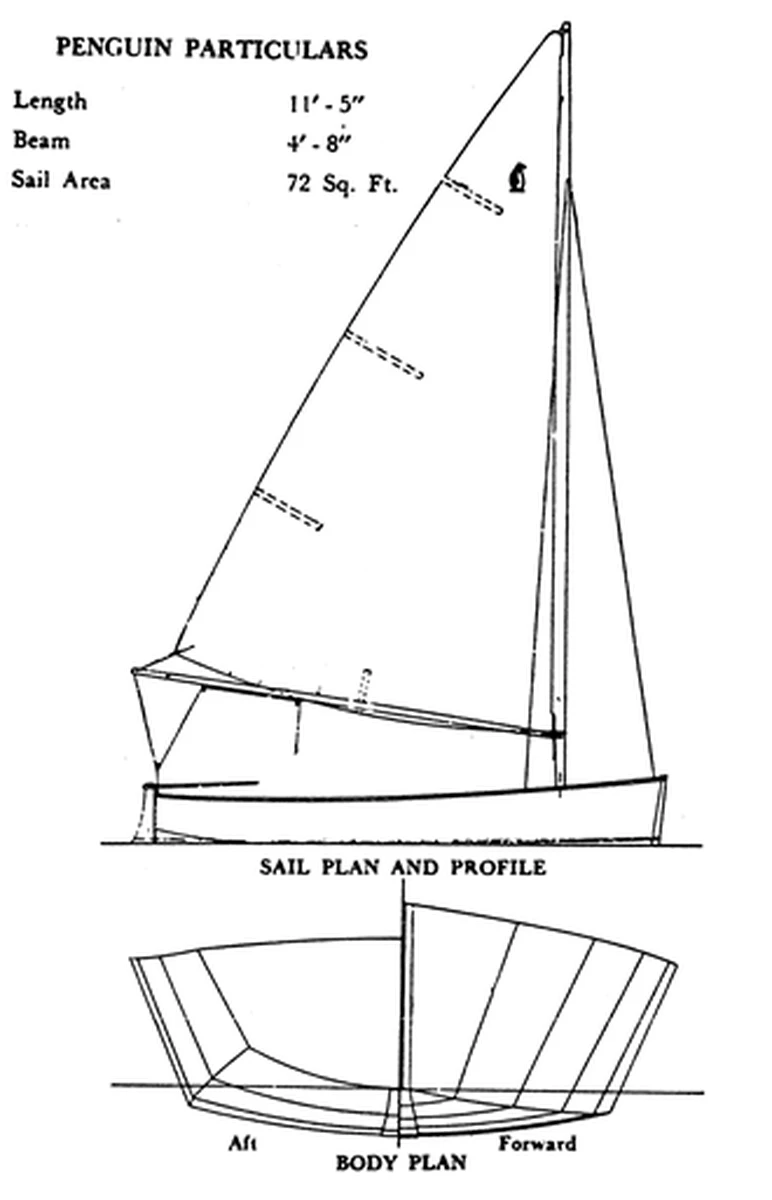
Penguin
Description
The Penguin (commonly known as the Penguin Class Dinghy or Penguin dinghy) is an American one-design racing dinghy designed by renowned naval architect Philip Rhodes in 1933, originally as a contender for frostbite racing fleets on the US East Coast (e.g., Manhasset Bay and Larchmont, New York). It gained popularity after Potomac River sailors revived it in 1938–1939, leading to the first fleet and class organization. The boat features plywood (originally) or fiberglass (approved 1959) construction, a hard-chined hull for easy amateur building from plans (still available today), a centerboard for shallow draft, a cat (Marconi) rig, and a simple, family-friendly setup suitable for frostbiting (winter racing), club racing, youth training, and daysailing. It's unballasted, relies on crew hiking for stability, and emphasizes close, competitive racing with strict one-design rules. Production has been primarily amateur/home-built or small-shop (e.g., Bristol Seacraft in Rhode Island as a modern wooden builder), with over 9,700 hulls built historically (one of the most prolific home-built classes), and the International Penguin Class Dinghy Association maintains active fleets, rules, and events today.
Construction Details
| Designer | Philip L. Rhodes |
|---|---|
| Builder | Bristol Seacraft |
| Length | 21.000 ft |
| LOA | 11.420 ft |
| Beam | 4.670 ft |
| Displacement | 140 lb |
| Max Draft | 3.830 ft |
| Min Draft | 0.330 ft |
The standard boat dimensions
| i | - |
|---|---|
| j | - |
| p | 20.40 ft |
| e | 7.80 ft |
| p2 | - |
| e2 | - |
| i2 | - |
| j2 | - |
| I | J | P | E | P2 | E2 | I2 | J2 |
|---|---|---|---|---|---|---|---|
| - | - | 20.40 ft | 7.80 ft | - | - | - | - |
Sails
Penguin - JIBSAIL
| Luff | 17.72 ft - (5401 mm) |
|---|---|
| Foot | 10.83 ft - (3301 mm) |
| Leech | 13.58 ft - (4139 mm) |
| Length Perpendicular | * 8.29 ft - (2527 mm) |
| Area | * 73.47 ft² |
| Edit in Calculator |
Penguin - GAFF MAIN
| Luff | 10.89 ft - (3319 mm) |
|---|---|
| Foot | 13.78 ft - (4200 mm) |
| Leech | 20.67 ft - (6300 mm) |
| Tack Angle | * 87.52 ° |
| Diag (clew/throat) | 17.19 ft - (5240 mm) |
| Head | 10.5 ft - (3200 mm) |
| Area | * 165.05 ft² |
| Edit in Calculator |
Disclaimer. Boats are not all the same -- even when produced in the same factory of the same model. Sailrite does its best to publish accurate dimensions, but we often find it worthwhile to have our customers measure their boats carefully before we produce kits for them. You should take the same precautions, especially when the data is not from Sailrite. The information on this site is not guaranteed to be accurate. Sailrite offers this content as a service to our community, but takes no responsibility for the reliability of the data provided.
Comments


