

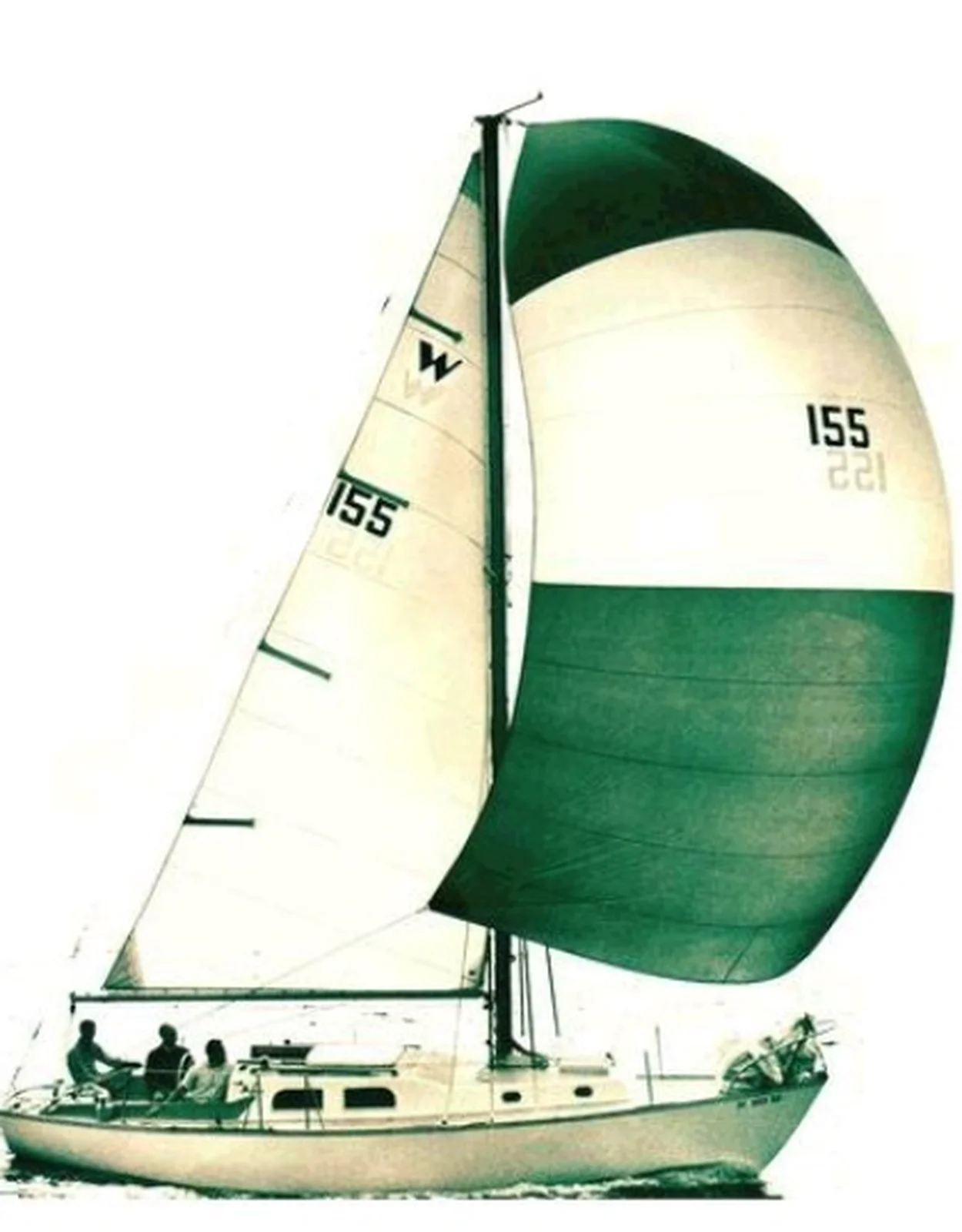
Pearson Wanderer 30
Description
The Pearson Wanderer 30 is a shoal-draft fiberglass cruiser-racer designed by William H. "Bill" Shaw for Pearson Yachts, produced from 1966 to 1971 as a versatile masthead sloop blending racing prowess with family cruising capabilities, featuring a keel-centerboard configuration for shallow-water access and balanced performance under CCA rules. With its generous beam, long waterline, and hand-laid solid fiberglass hull (no core), it emphasizes seaworthiness and interior volume, sleeping six in a practical layout powered by the reliable Universal Atomic 4 gasoline engine, and was priced around $15,000–$18,000 new—positioning it as an accessible "go-anywhere" 30-footer for coastal passages or club races. Designed in 1965 by Shaw—Pearson's in-house naval architect since 1964—the Wanderer debuted in 1966 amid the fiberglass revolution, drawing inspiration from Shaw's earlier Tartan 27 and Pearson models like the Coaster (full-keel variant) and Vanguard, with a focus on shoal draft for inlets while qualifying for major offshore races via its 30 ft LOA. Built exclusively at Pearson's Portsmouth, Rhode Island facility under Grumman Allied Industries, 177 units were hand-laid with thick, durable hulls (though minor variations in keel voids and fillers occurred due to manual processes), achieving immediate success with strong race results and owner acclaim. In 1970, updates refined the rig (higher aspect ratio for larger headsails without rating penalty) and interior for enhanced comfort; production ended in 1971 as Pearson shifted to fin-keel designs like the Pearson 30. A rare pilothouse variant (Wanderer 300) was produced ~1969–1970 in limited numbers (~100), but the standard model remains the focus of its enduring fleet.
Construction Details
| Designer | William H. "Bill" Shaw |
|---|---|
| Builder | Pearson Yachts |
| Length | 30.250 ft |
| LOA | 30.250 ft |
| LWL | 23.330 ft |
| Beam | 9.330 ft |
| Displacement | 9000 lb |
| Ballast | 3800 lb |
| Max Draft | 7.000 ft |
| Min Draft | 3.500 ft |
| Year Built | 1966 |
The standard boat dimensions
| i | 36 ft |
|---|---|
| j | 11.33 ft |
| p | 31 ft |
| e | 14 ft |
| p2 | - |
| e2 | - |
| i2 | - |
| j2 | - |
| I | J | P | E | P2 | E2 | I2 | J2 |
|---|---|---|---|---|---|---|---|
| 36 ft | 11.33 ft | 31 ft | 14 ft | - | - | - | - |
Sails
Pearson Wanderer 30 - MAINSAIL
| Luff | * 31 ft - (9449 mm) |
|---|---|
| Foot | * 13 ft - (3962 mm) |
| Leech | * 32.91 ft - (10031 mm) |
| Tack Angle | * 88 ° |
| Diagonal | * 33.19 ft - (10116 mm) |
| Head (inches) | * 6 in - (152 mm) |
| Area | * 208.22 ft² |
| Edit in Calculator | |
Pearson Wanderer 30 - JIBSAIL
| Luff | * 30.36 ft - (9254 mm) |
|---|---|
| Foot | * 16.01 ft - (4880 mm) |
| Leech | * 26.18 ft - (7980 mm) |
| Percentage LP | * 115 % |
| Length Perpendicular | * 13.8 ft - (4206 mm) |
| Deck Angle | * 12.01 ° |
| Area | * 209.51 ft² |
| Edit in Calculator | |
Pearson Wanderer 30 - GENOA
| Luff | * 36.05 ft - (10988 mm) |
|---|---|
| Foot | * 19.47 ft - (5934 mm) |
| Leech | * 33.82 ft - (10308 mm) |
| Percentage LP | * 150 % |
| Length Perpendicular | * 18 ft - (5486 mm) |
| Deck Angle | * 3.96 ° |
| Area | * 324.47 ft² |
| Edit in Calculator | |
Pearson Wanderer 30 - GENOA
| Luff | 35 ft - (10668 mm) |
|---|---|
| Foot | 20 ft - (6096 mm) |
| Leech | 33 ft - (10058 mm) |
| Percentage LP | * 154 % |
| Length Perpendicular | * 18.48 ft - (5633 mm) |
| Deck Angle | * 4.08 ° |
| Area | * 323.33 ft² |
| Edit in Calculator | |
Pearson Wanderer 30 - ASYMMETRICAL
| Luff | * 36.05 ft - (10988 mm) |
|---|---|
| Foot | * 19.8 ft - (6035 mm) |
| Leech | * 33.17 ft - (10110 mm) |
| Perc LP | * 165 % |
| Area | * 535 ft² |
| Edit in Calculator | |
Pearson Wanderer 30 - SPINNAKER
| Stays | * 36.05 ft - (10988 mm) |
|---|---|
| MidGirth | * 21.6 ft - (6584 mm) |
| Foot | * 21.6 ft - (6584 mm) |
| Perc LP | * 180 % |
| Area | * 662 ft² |
| Edit in Calculator | |
Disclaimer. Boats are not all the same -- even when produced in the same factory of the same model. Sailrite does its best to publish accurate dimensions, but we often find it worthwhile to have our customers measure their boats carefully before we produce kits for them. You should take the same precautions, especially when the data is not from Sailrite. The information on this site is not guaranteed to be accurate. Sailrite offers this content as a service to our community, but takes no responsibility for the reliability of the data provided.