

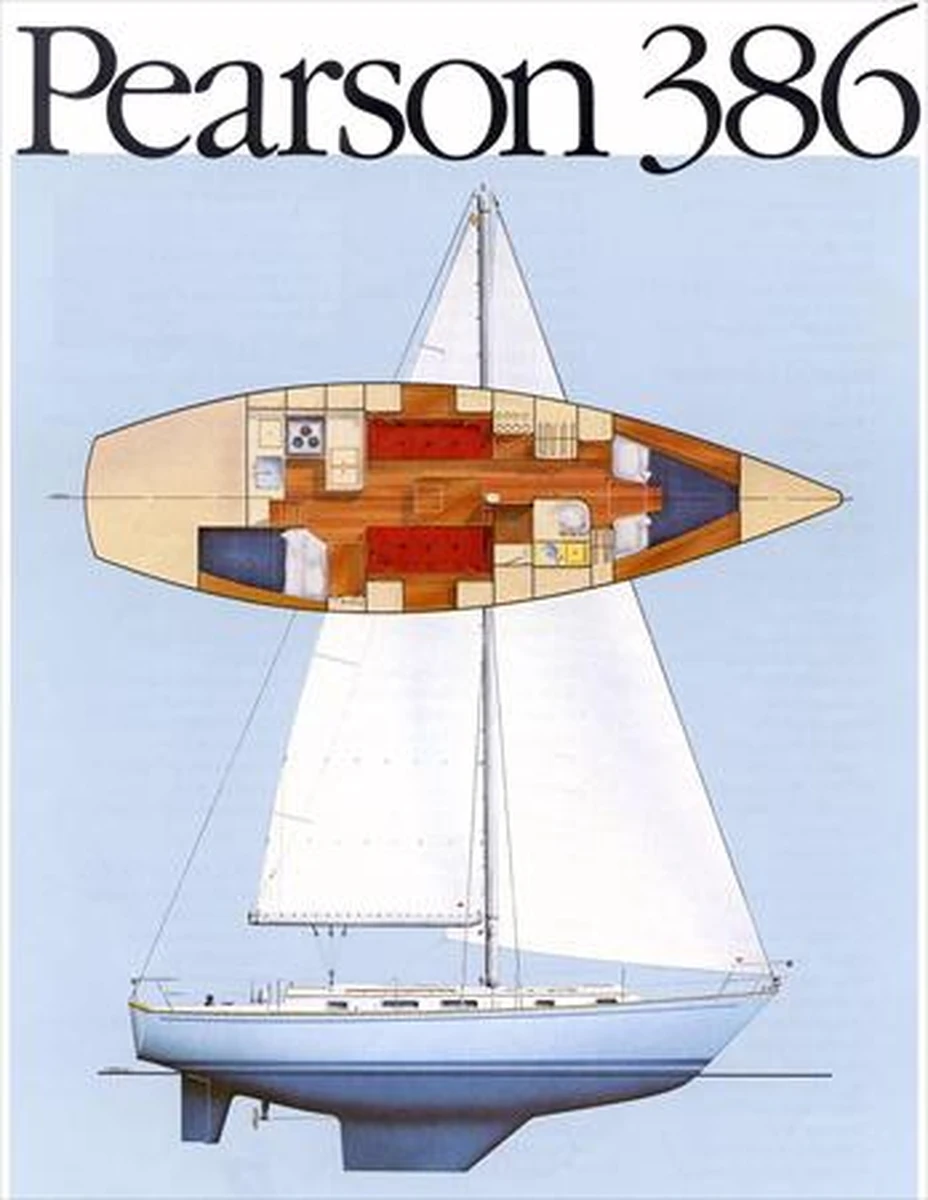
Pearson 386 Ketch
Description
The Pearson 386 Ketch is a rare aft-cockpit variant of the acclaimed Pearson 386 cruising sailboat, tailored for bluewater and coastal passages with the divided sail plan of a ketch rig for simplified handling and balanced power. Sharing the same hull as the more common sloop or cutter 386, it features a spacious interior, moderate beam for stability, and a focus on comfort for extended voyages. The aft cockpit provides a more social, open feel compared to the center-cockpit 385, while the ketch configuration—shorter main mast, small mizzen aft—eases reefing for short crews and reduces boom loads. Ideal for couples or small families, it's praised for light-air performance and seaworthiness, though its scarcity limits parts availability. Owners note its "go-anywhere" attitude, with easy motion in slop and proven transoceanic capability. Designed by William H. Shaw in 1983, the Pearson 386 debuted in 1984 as an evolution of the center-cockpit 385, shifting to an aft cockpit for better visibility and cockpit lounging while retaining Shaw's emphasis on performance-oriented cruising. Built by Pearson Yachts in Portsmouth, Rhode Island, production spanned 1984-1985, with approximately 50-60 hulls total—predominantly sloops or cutters. The ketch rig was a limited factory option (estimated 3-5 built, based on sailmaker records and owners' forums), appealing to traditionalists favoring sail division over single-mast power. This marked one of Pearson's final designs before the company's 1986 closure amid industry recession. The model drew from Shaw's earlier successes like the 365, blending racer-cruiser DNA with liveaboard amenities. Today, the Pearson Yachts Owners Portal (pearsonyachts.org) and forums like Cruisers Forum support the fleet, though ketch-specific resources are thin.
Construction Details
| Designer | William H. "Bill" Shaw |
|---|---|
| Builder | Pearson Yachts |
| Length | 38.250 ft |
| LOA | 38.250 ft |
| LWL | 30.000 ft |
| Beam | 11.500 ft |
| Displacement | 16915 lb |
| Ballast | 7000 lb |
| Max Draft | 55.000 ft |
| Year Built | 1984 |
The standard boat dimensions
| i | 44.75 ft |
|---|---|
| j | 16.50 ft |
| p | 38.50 ft |
| e | 11.75 ft |
| p2 | 24 ft |
| e2 | 7.83 ft |
| i2 | - |
| j2 | - |
| I | J | P | E | P2 | E2 | I2 | J2 |
|---|---|---|---|---|---|---|---|
| 44.75 ft | 16.50 ft | 38.50 ft | 11.75 ft | 24 ft | 7.83 ft | - | - |
Sails
Pearson 386 Ketch - MAINSAIL
| Luff | * 38.5 ft - (11735 mm) |
|---|---|
| Foot | * 11.75 ft - (3581 mm) |
| Leech | * 39.73 ft - (12110 mm) |
| Tack Angle | * 88.01 ° |
| Diagonal | * 39.86 ft - (12149 mm) |
| Head (inches) | * 5.25 in - (133 mm) |
| Area | 225.95 ft² |
| Edit in Calculator |
Pearson 386 Ketch - JIBSAIL
| Luff | * 38.16 ft - (11631 mm) |
|---|---|
| Foot | * 22.43 ft - (6837 mm) |
| Leech | * 32.34 ft - (9857 mm) |
| Percentage LP | * 115 % |
| Length Perpendicular | * 18.98 ft - (5785 mm) |
| Deck Angle | * 12 ° |
| Area | 361.95 ft² |
| Edit in Calculator |
Pearson 386 Ketch - GENOA
| Luff | * 45.31 ft - (13810 mm) |
|---|---|
| Foot | * 27.14 ft - (8272 mm) |
| Leech | * 42.19 ft - (12860 mm) |
| Percentage LP | * 150 % |
| Length Perpendicular | * 24.75 ft - (7544 mm) |
| Deck Angle | * 4 ° |
| Area | 560.67 ft² |
| Edit in Calculator |
Pearson 386 Ketch - MIZZEN
| Luff | * 24 ft - (7315 mm) |
|---|---|
| Foot | * 7.83 ft - (2387 mm) |
| Leech-AftHdBd | * 24.89 ft - (7586 mm) |
| Tack Ang | * 87.97 ° |
| Diag (clew/head) | * 24.98 ft - (7614 mm) |
| Head (inches) | * 3.5 in - (89 mm) |
| Area (no Roach) | 93.85 ft² |
| Edit in Calculator |
Disclaimer. Boats are not all the same -- even when produced in the same factory of the same model. Sailrite does its best to publish accurate dimensions, but we often find it worthwhile to have our customers measure their boats carefully before we produce kits for them. You should take the same precautions, especially when the data is not from Sailrite. The information on this site is not guaranteed to be accurate. Sailrite offers this content as a service to our community, but takes no responsibility for the reliability of the data provided.
Comments


